Scientific

a Urea Breath Test perfectly suited for primary diagnosis and for post treatment follow-up of Helicobacter pylori infection.
It is a reliable, safe and cost-effective near-patient testing system consisting of three components: HeliCap™, BreathCard™ and Heliprobe® Analyzer.

Diagnostic methods

Kibion will participate in the following exhibitions.
Please come and meet us there.

Currently used invasive tests, based on the analysis of biopsies obtained during endoscopy, include:

  • Biopsy Urease Testing
  • Fibroscopy
  • Bacterial Culture
  • Polymerase Chain Reaction (PRC)

Non-invasive tests are:

  • Serology
  • Stool Antigen Tests
  • UBT (Urea Breath Test)

Each test method has its own advantages and disadvantages. Traditionally the easiest and least expensive test to perform has been serology. The accuracy of serological tests are questionable, with reported specificities as low as 75 %. Furthermore, serological tests cannot be used to verify eradication, as they only detect antibodies to Hp and not the active infection.

The presence of Helicobacter pylori in the stool of infected patients has led to the development of fecal assays. Over the last years these test have been improved and offer accurate diagnosis of Helicobacter pylori. Less data is available on how well suited this test is as a post eradication follow-up test. One obvious disadvantage is handling of the stool.

At present the most accurate and wide-spread, non-invasive method is the Urea Breath Test. It is considered as the golden standard by many experts. Like the biopsy urease test, the Urea Breath Test depends on the bacteria’s production of the enzyme urease. Breath testing for Helicobacter pylori measures active infection. It is a cost-effective method to diagnose Helicobacter pylori.

Focus on Urea Breath tests

The Helicobacter pylori breath test is a non-invasive diagnostic test that measures active Hp infection.
It is a cost-effective method for the diagnostic of Hp.

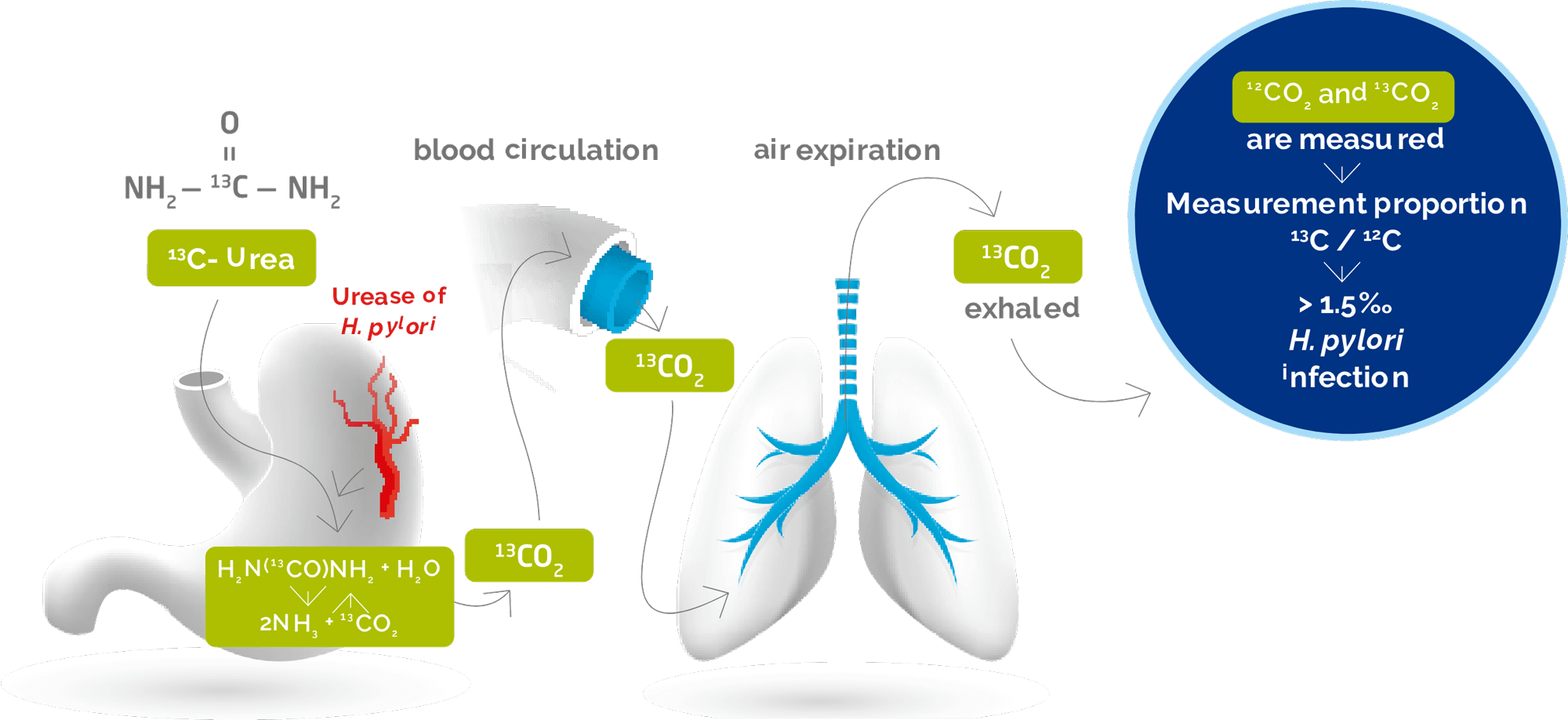
The Urea Breath Test exploits the production of an enzyme, urease, by Helicobacter pylori. This enzyme protects the bacteria from the acidic environment of the stomach by alkalizing the surrounding environment. This is accomplished by metabolizing urea into ammonia and carbon dioxide.

The carbon dioxide (CO2) produced diffuses into the blood vessels, is transported to the lungs, and expelled in exhaled air.

Test principles

On an empty stomach the patient swallows carbon labeled urea. In the presence of Helicobacter pylori, the labeled urea is metabolized into carbon dioxide and ammonia by the enzyme urease, produced by Helicobacter pylori. The carbon dioxide produced diffuses into the blood vessels and from there it is transported as bicarbonate into the lungs and expelled as CO2 with exhaled air to be captured during sampling. A positive answer offers conclusive evidence that the patient is infected with Helicobacter pylori. In the absence of Helicobacter pylori, the administered urea is absorbed from the gastrointestinal tract and subsequently voided.

Diagnostic guidelines

An infection with Helicobacter pylori is generally associated with a range of serious consequences for the health of the affected individual.

There is a correlation between H.pylori infection and gastric/duodenal ulcer and malignant gastric illnesses.

This raises the question as to who needs to undergo diagnosis for H.pylori, and if found positive, which treatment to receive.

Who should be tested?

  • Uninvestigated dyspepsia (<50 y, no alarm signs) → Non-invasive test (UBT or stool antigen).
  • >50 y (≈45–55 depending on region) or alarm signs → Endoscopy with biopsies & gastritis staging.
  • Peptic ulcer disease (active or past) → Test & treat.
  • Gastric MALT lymphoma → Test & treat.
  • History of gastric neoplasia resection → Test & treat.
  • Long-term PPI users → Test & treat.
  • Extra-digestive conditions: unexplained IDA, vitamin
  • B12 deficiency, ITP → Test & treat.
  • Before NSAIDs (new users) → Test & treat.
  • Aspirin users at high GI risk (e.g. ulcer history) → Test & treat (+/- PPI).
  • Family history of gastric cancer (1st degree) → Test & treat, often with endoscopy.
  • Population screening in regions with intermediate/high gastric cancer risk.

How to test?

  • Preferred: UBT or monoclonal stool antigen test.
  • Serology only for epidemiological programs – confirm positive results before treatment.
  • Antibiotic susceptibility testing (AST) for clarithromycin (PCR/culture) before prescribing CLA regimens.

A report delivered by experts at the Maastricht IV/Florence Consensus Conference (The European Helicobacter Study Group (EHSG). Management of Helicobacter pylori infection – the Maastricht IV/ Florence Consensus Report. Gut 2012; 61:646-664.) included the following statements for the management of Helicobacter pylori infection:

  • A test-and -treat strategy is appropriate for uninvestigated dyspepsia in populations where the H.pylori prevalence is high (≥ 20 %). This approach is subject to local cost-benefit considerations and is not applicable to patients with alarm symptoms such as weight loss, dysphagia, GI bleeding, abdominal mass and iron deficient anaemia.
  • The main non-invasive tests that can be used for the test-and-treat strategy are the UBT and monoclonal stool antigen tests.
  • H.pylori eradication produces long-term relief of dyspepsia in one of 12 patients with H.pylori and functional dyspepsia; this is better than any other treatment.
  • Long-term treatment with PPIs in H.pylori-positive patients is associated with the development of a corpus-predominant gastritis. This accelerates the process of loss of specialized glands, leading to atrophic gastritis.
  • Eradication of H.pylori in patients receiving long-term PPIs heals gastritis and prevents the progression to atrophic gastritis.

Helicobacter pylori
general information

Helicobacter pylori (H. pylori) is a common bacterium which infects the inside lining of the stomach.
Acquired mainly during childhood, H. pylori can persist for a lifetime if not treated.

H. pylori leads to inflammation of the stomach (gastritis) which generally goes unnoticed. It may cause gastrointestinal disorders (discomfort, pain) and overtime may develop into an ulcer, a sore in the lining of the stomach or duodenum. More rarely, H. pylori may develop into gastric cancer.

Treatment to eradicate the bacterium and prevent the occurrence of disease is available.

Helicobacter pylori
infection

Helicobacter pylori (H. pylori) is a common bacterium which infects the inside lining of the stomach.
Acquired mainly during childhood, H. pylori can persist for a lifetime if not treated.

H. pylori leads to inflammation of the stomach (gastritis) which generally goes unnoticed. It may cause gastrointestinal disorders (discomfort, pain) and overtime may develop into an ulcer, a sore in the lining of the stomach or duodenum. More rarely, H. pylori may develop into gastric cancer.

Treatment to eradicate the bacterium and prevent the occurrence of disease is available.

The consequences are sometimes serious 1,2,3

Different situations that could alert you 4

Stomach pain

Discomfort

Indigestion
or a feeling of
stomach heaviness

Relatives
a 1st degree relative
who has or had stomach
pre-cancerous or
cancerous lesions

«This list is non-exhaustive; provided for information purposes. It is recommended to consult your doctor.»

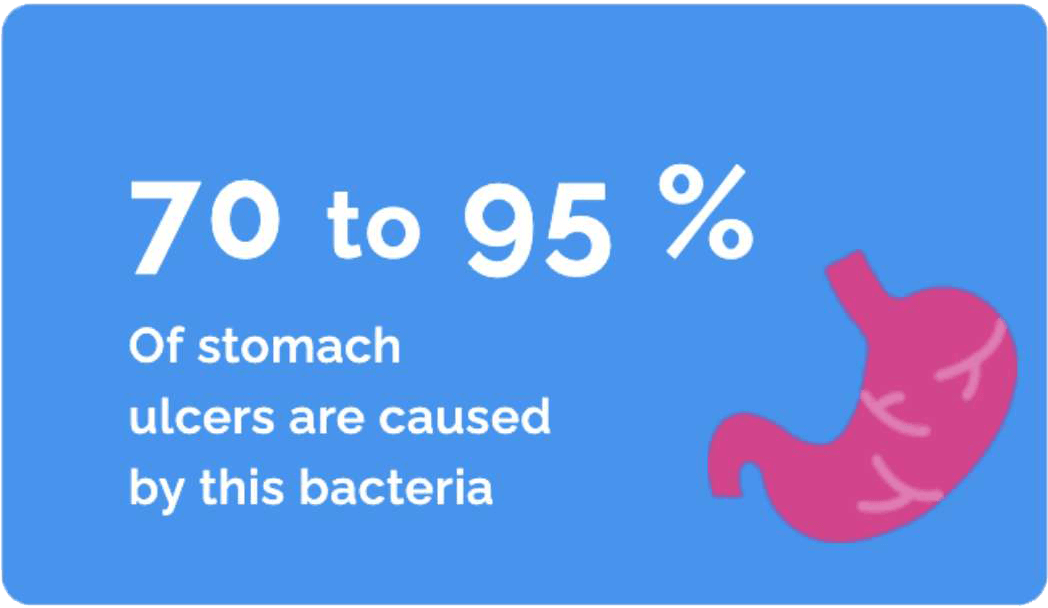
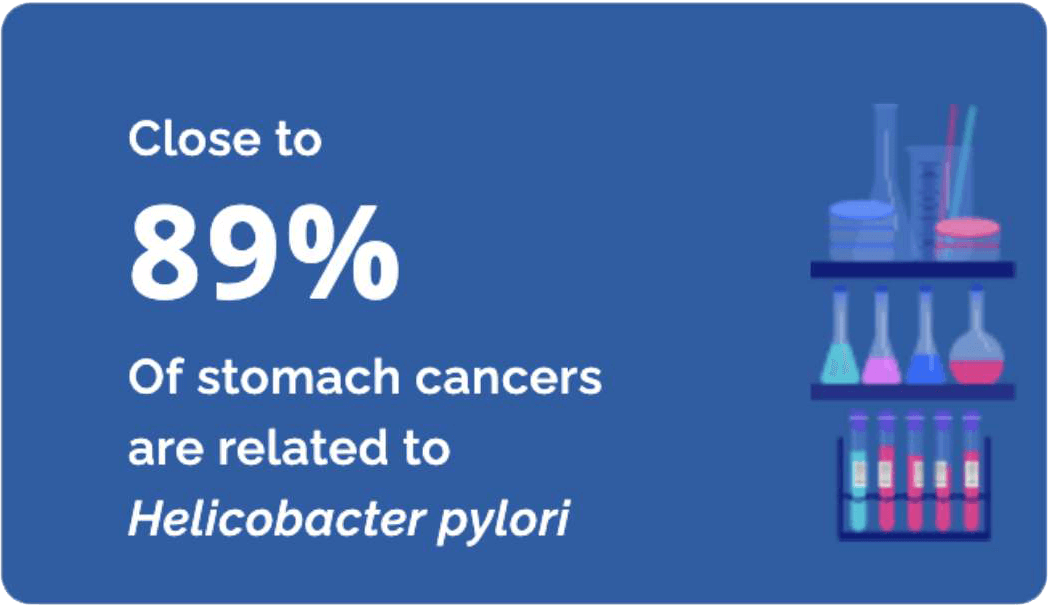
Stomach inflammation (gastritis) often goes unnoticed and does not cause any symptoms for several years. Problems with the stomach (e.g. stomach pain) can also happen and get worse over time, leading to conditions like ulcers and, rarely, stomach cancer. Bacteria are very important in causing ulcers. Most ulcers (70 to 95%) are linked to a Helicobacter pylori infection. It is also responsible for most stomach cancers (up to 89%). If you have any of these symptoms, you should see your doctor straight away. You might have a stomach infection called Helicobacter pylori.2,3

There can be many different reasons for stomach pain, simple reasons which disappear without treatment, but it can also be serious and even life-threatening causes behind the stomach problems.

Stomach pain is a very common condition and the third reason for a doctor’s visit after headache and fatigue. The most important reason for getting an ulcer is the infection of the bacteria Helicobacter pylori.

Helicobacter pylori is the world’s most common infectious disease and it is estimated that 50 % of the world’s population is infected.

Visit web site for more information

References:
1. Hooi JKY, Lai WY, Ng WK, et al. Global Prevalence of Helicobacter pylori Infection: Systematic Review and Meta-Analysis. Gastroenterology. 2017 Aug;153(2):420-429.
2. HAS, Treating Helicobacter pylori, March 2019
3. Pasteur Institute, https://www.pasteur.fr/en/medical-center/disease-sheets/stomach-cancer-and-gastric-ulcers#:~:text=duodenal%20ulcer%20develops.-,H.,and%2070%25%20of%20gastric%20ulcers, consulted 11/06/2025
4. HAS, Screening for Helicobacter pylori, March 2019
5. HAS, Diagnosis of Helicobacter pylori infection in adults, May 2017